
Measuring a foot before you pick a size
A pull-on boot has no laces to take up slack, so length is the one thing you cannot correct afterwards. Here is how we would measure it.
Nearly every sizing complaint we read comes down to the same thing: the size was chosen from memory rather than from a measurement. A boot is not a sneaker. There is no lacing to pull the foot back into the heel, so if the length is wrong the foot moves, and the pair that felt fine standing in the hallway rubs by the afternoon.
The measurement itself takes two minutes and a sheet of paper.
The four things that change the number
- Time of day. A foot spreads and lengthens over a day on it. Measure in the evening and you are measuring the foot the boot actually has to hold.
- Weight on the foot. Sitting down gives you a shorter foot than standing does. Stand.
- The sock. Measure in the sock you intend to wear. A thick boot sock is worth the better part of a half size, which is why the same person can need two different sizes in summer and in winter.
- Which foot. Most people have one longer than the other. Work from the longer one, always.
Taking it
Put the paper flat against a skirting board, stand with the heel pressed to the wall, and mark the paper at the tip of the longest toe. That is not always the big toe, and if you have never checked, this is the moment. Measure between the wall edge and the mark. That number is what our grid answers to.
What the grid gives back
The column we publish is the length inside the boot, not the length of the foot that suits it. A foot exactly as long as the figure will touch both ends of the boot. That is why the bench shows you the size your foot fits into and the next one up together, with the room each leaves in inches, instead of announcing one answer.
How much room you want is genuinely your call. A thin sock and a low instep can live with very little. A thick sock, a high instep, or feet that swell in heat want more. We do not publish an allowance of our own, so we are not going to invent one here.
Between two sizes
Go up. A boot slightly too long can be brought back under control with a thicker sock or an insole. A boot slightly too short has nothing you can do to it. That is also what the people who wrote to us about sizing say, by a wide margin, in both directions.
The grid our women's lasts agree on, across 37 of our own charts. Inside length is the boot, not the foot.
| Our size | Inside length | Charts agreeing |
|---|---|---|
| 5 | 8.6 in | 37 |
| 5.5 | 8.8 in | 37 |
| 6 | 8.9 in | 37 |
| 6.5 | 9.1 in | 37 |
| 7 | 9.3 in | 37 |
| 7.5 | 9.4 in | 37 |
| 8 | 9.6 in | 37 |
| 8.5 | 9.8 in | 37 |
| 9 | 9.9 in | 37 |
| 9.5 | 10.1 in | 37 |
| 10 | 10.3 in | 37 |
| 10.5 | 10.4 in | 37 |
| 11 | 10.6 in | 37 |
| 11.5 | 10.8 in | 30 |
Pairs that carry their own chart
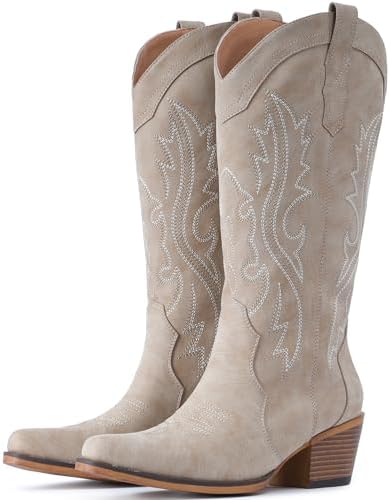 Cowboy Boots For Women Western Cowgirl Boots Mid Calf Snip Toe$52.19 to $54.99★★★★★ 4.4 (3,543)
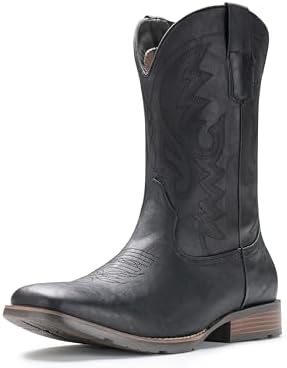 Cowboy Boots For Men Western Boot Durable Fashionable Retro$46.99 to $57.99★★★★★ 4.3 (2,406)
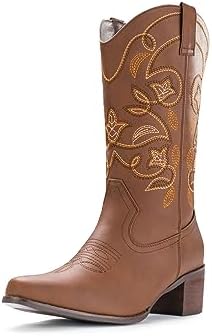 Cowboy Boots For Women Pointy Toe Western Boots Cowgirl Boots$22.79 to $34.99★★★★★ 4.4 (2,193)
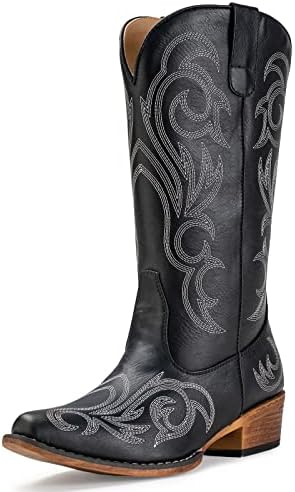 Cowboy Boots For Women Mid Calf Cowgirl Boots Pointy Toe Western$19.99★★★★★ 4.5 (1,411)
More from the bench
- When a shaft will not closeSizing up in the foot does not fix a calf. What the opening figure means, where it comes from, and what to do when the numbers are close.
- Breaking in a new pairWhat actually softens, how long it takes, and which kinds of discomfort mean the boot is wrong rather than new.
- Suede and what it asks forNapped leather is the same hide with a different face. It wants a brush and a dry spell, not a cloth and water.